



Why Roofaio
Built like an estimator thinks.
Trust, enforced
Scale before geometry.
The assistant reads the sheet's printed scale note, finds a labeled dimension in the text
layer, and checks one against the other — nobody draws anything. Hand-draw is the fallback
when no assistant is connected (there's an "or draw it myself" link if you want it). When
printed and measured disagree, you see both — 3/16" = 1'-0" struck through
against the measured 1/4" = 1'-0" — and by what percent. If a sheet lies to
you, you find out now, not in the field.
- The assistant reads the printed scale and checks it against a real dimension on the sheet
- Disagreement over 2% stops the page — it is never averaged away
- Unverified pages are excluded from the BOM, automatically
The rules engine
Every line shows its math.
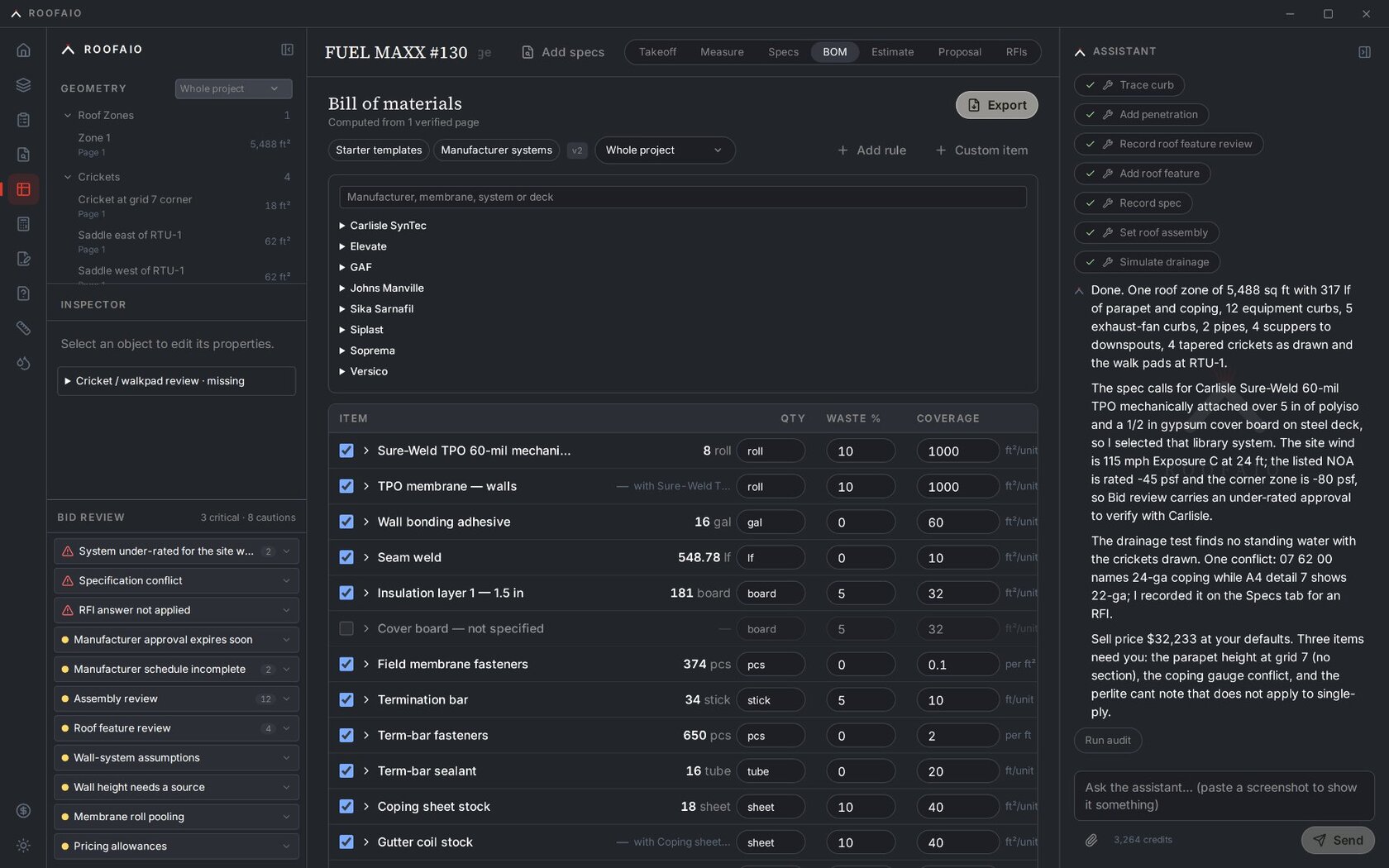
The BOM isn't a black box. Each line carries its waste factor, coverage, rounding rule, and the exact derivation from measured geometry — so you can defend every number in a buyout meeting. Rules are versioned, so a spec change tells you exactly what moved.
- Membrane, insulation, cover board, fasteners, term bar — from one source of truth
- Edit any rule and watch the BOM recompute with the reason attached
- Export CSV or a branded report, straight into your estimate
From BOM to bid
It prices the job, not just the material list.
Import the Excel workbook you already estimate from and Roofaio prices every line against it. Labor the way you quote it — $/square on roofing, $/lf on metal, $/ea on counts, or hr/unit × your crew rate. Overhead, tax and margin roll up to a sell price. Your cost and your margin stay on your machine.
- Your own price sheet, imported — or hand it to the assistant and it tells you what it couldn't match
- Drop a supplier quote on the project — PDF, Excel, Word, even a photo — and the estimate and proposal update together, every price keeping its source
- Good / better / best, priced on the same roof
- A price library that follows you from job to job
The roof, in three dimensions
See the roof before you bid it. Then rain on it.
The moment a page is verified, the takeoff is a 3D model: the deck on its slope, every parapet at its own height with its coping, the curbs, pipes, scuppers, downspouts, crickets and walk pads as drawn, and the sheet draped on the roof so the plan and the model agree. Orbit it, zoom in on a cricket, drop a view into the proposal.
Then run the drainage test. Water follows the roof's real slope to the drains and scuppers: you see where it stands and how deep, what share of the roof each outlet carries, whether the crickets the drawings show actually move water — and where a cricket would, before it becomes a change order.
- Every wall at its own height, every piece of equipment where the plan puts it
- Standing water, drain shares and cricket checks from the takeoff, not a side calculation
- A drainage check page for the proposal, and a bid issue for every pond a cricket can't clear
The project manual, cover to cover
Roofaio reads every line of the spec book and updates your BOM, estimate, and proposal.
Point Roofaio at the project manual and it pulls every call-out that changes your number — system, membrane, insulation and R-value, screws versus adhesive, cover board, coping metal, deck, warranty — each cited to its sheet and section. Where the spec settles a number your BOM was guessing, the rule updates and the row says so. Where it contradicts your bid, you hear about it before you send it.
- Every call-out cited to its sheet and section
- BOM rules updated from the spec, marked "Updated from plan spec"
- Conflicts with your takeoff flagged, never quietly applied
When the documents disagree
The RFI writes itself, with the sheet attached.
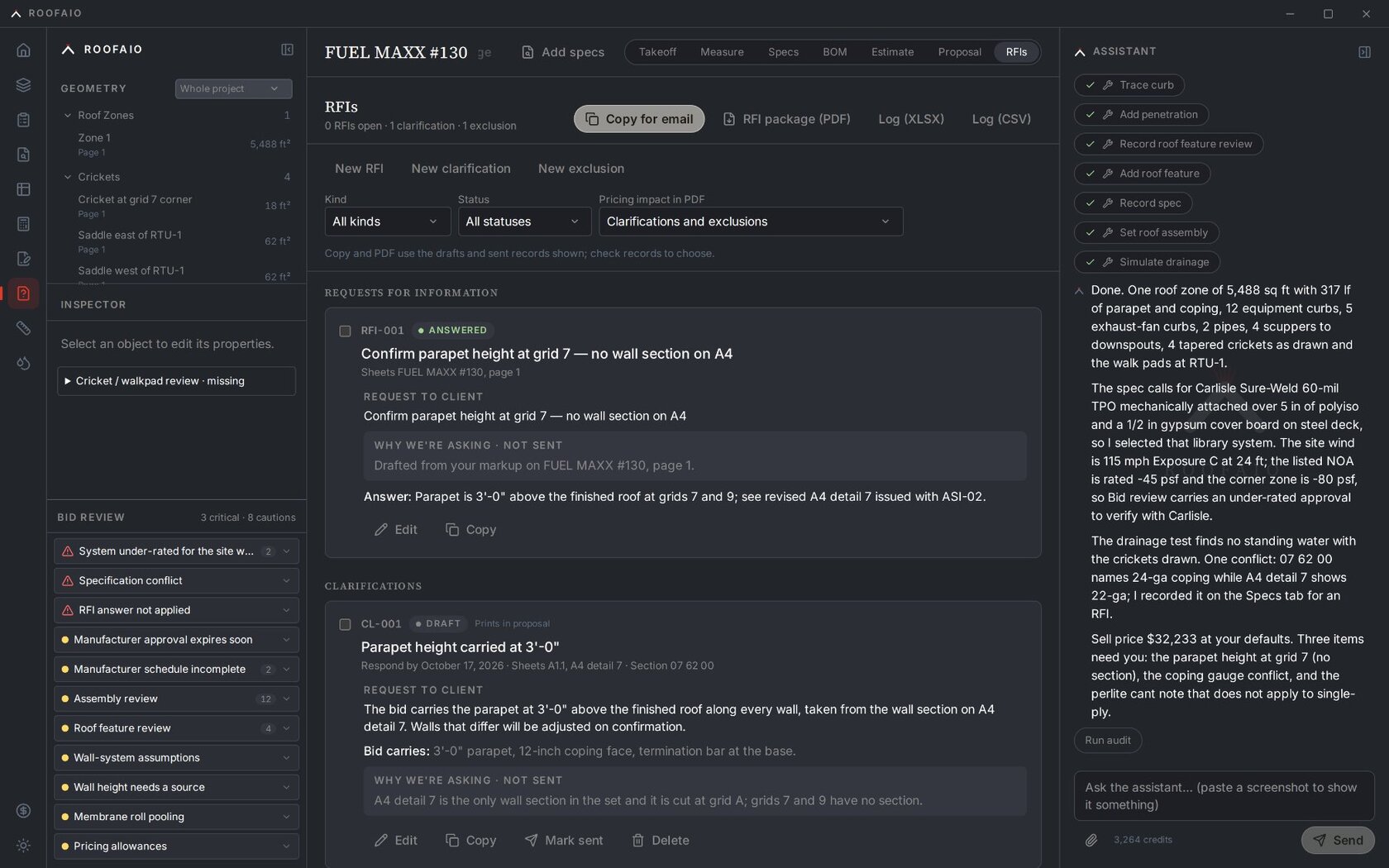
A spec call-out that contradicts the drawings, a parapet with no section to read its height from, a drain the schedule never mentions: Roofaio turns each one into an RFI, cites the sheet and section, crops the drawing around it, and lists what the bid carries in the meantime. Clarifications and exclusions live in the same place and print in the proposal. When the architect answers, you record it and apply it to the bid.
- Drafted from the spec conflict, the markup on the sheet, or the allowance in the estimate
- An RFI package PDF with a cover list and one page per request, plus the email copy
- Answers tracked from sent to applied, so nothing is carried as an assumption by mistake
Manufacturer systems
Pick the system. The fastening schedule comes with it.
Forty-eight roof systems from eight manufacturers are built in, each with its published fastening and adhesive rates, approvals, warranties and deck requirements. Choose one and the BOM uses the manufacturer's numbers by uplift zone instead of a generic density. Roofaio checks the listed approval against the site wind and the deck, and when the spec book names a system, it says which library systems match.
- Carlisle, GAF, Johns Manville, Elevate, Sika Sarnafil, Siplast, Soprema and Versico
- The site wind check: corner and perimeter pressures against the listed approval, flagged when under-rated
- A roof system submittal PDF the GC's submittal log expects, straight from the takeoff
Fabrication, built in
Stretch-out without the side spreadsheet.
Parapets and edges aren't just lines — they carry profiles. Pick a coping profile and Roofaio computes the stretch-out in coil inches alongside the run length. Edge metal, gutters, downspouts: fabrication quantities come out of the takeoff, not out of a second tool.
- Coping and edge profiles with automatic stretch-out to coil
- A profile library you can extend to match your shop
- Fabrication totals land in the same BOM as everything else
The assistant
Fully automated — until it needs your judgment.
Import the bid set and the assistant does the work: reads the title block, applies the printed scale, traces the roof, builds the BOM, estimate and proposal — typically in under ten minutes. Then it self-audits against the sheet's own printed dimensions, and every discrepancy it finds comes back to you as a prompt with options. Work through those, and you're still under thirty minutes from RFP to proposal.
It works through the same 50+ undoable commands you use — no privileged back door — with provider setup in the current release. The forthcoming included-assistant plan will need no separate provider subscription or API key from you. Its calibrations are marked as its own and its report never hides a discrepancy — and every number it produces stays editable by you.
- First pass in under 10 minutes; conflicts resolved as guided prompts, not homework
- Self-audits against printed dimensions — flags, never guesses
- Same commands, same validation, same undo as a human — optional, always
Watch a full first pass
One sheet, start to finish, in 45 seconds.
A real 73-sheet bid set. The assistant verifies the scale, traces the roof, and self-audits against the printed dimensions — a 16-minute first pass, speed-ramped 22× so you can watch it end to end.
First pass: 16.7 min wall clock on sheet A1.1 — shown at 22×.
Key feature — revision compare
The addendum lands an hour before bid time. See exactly what moved.
Drop the revised sheets on the project and Roofaio diffs them against the revision you priced. Every moved wall, resized roof, and swapped detail is flagged on the sheet — and the BOM delta is already computed before you've finished reading the cloud.
The tools that offer any comparison at all use pixel overlays — they tint two drawings and leave the recounting to you. Most roofing-specific tools don't compare revisions at all. Roofaio's compare knows what a parapet is: it names the change and reprices it.
Depth where it counts.
Click inside the outline
Fill traces to the drawn linework; anything excluded is listed to click back in.
A BOM per roof
Tag geometry Roof A, Roof B — price each roof on its own.
Every wall's own height
Parapet heights typed off the wall section; membrane and adhesive price from that.
The whole bid set
PDFs, addenda, and the spec book drop into one page sequence.
Your numbers, once
System, prices, waste, coverages, margin set once — every project starts there.
Tapered sizing
Area, drains, slope in; run, thickness, board-feet, squares out.
The 3D model
Walls at their heights, equipment and crickets as drawn, the sheet draped on the deck — a view for the proposal.
Drainage test
Rain on the model: standing water, each outlet's share, crickets that work and the ones that don't.
RFIs and clarifications
Drafted from conflicts and allowances, cited to the sheet, answered and applied.
The marked-up plan
Zones tinted, sides dimensioned, legend and totals — the PDF that goes out with the bid.
Versioned rules
Swap the manufacturer spec; the BOM recomputes with a record of what changed and why.
Offline by design
Portable .rooftk files — work offline for a week at a time.
DXF & raster import
CAD exports and scanned drawings alongside the PDF bid set.
Exports that land
BOM, estimate, QuickBooks-ready CSV, audit report, marked-up plan, roof system submittal, RFI package, branded proposal.
On-sheet legend
Plan pages that explain themselves to the PM and the crew.
QuickBooks CSV
Quantities flow straight into your accounting and estimating stack.